Sunday, October 21, 2007

Prescriptive and descriptive grammar

The August 22nd lecture "Prescriptive vs Descriptive Approaches to Grammar" by Dr. Amy Fountain, Adjunct Lecturer, Department of Linguistics, University of Arizona is the introduction to a linguistics lecture series that I found through iTunes U and is available as a podcast.

I used to be a stickler for rules in language. Not only in Dutch, also in English and Hebrew (and other languages I dabble in). Being explained in the is lecture the difference between prescriptive grammar (the stickler) and descriptive (whatever we find people use and passes for comprehensible and correct language), brightens up a whole area in my life. With regret I recall the useless discussions in my childhood whether a certain use of Dutch was correct or not. It was prescriptively incorrect en descriptively correct - nothing more nothing less. Could have thought of it myself, but never did.

So, I am going to go for more lectures. As opposed to what you might expect from a linguistic lecture, there is a lot of visuals going on. Even to the point of certain texts, sentences, words, shown in Dr. Fountain's power point and she doesn't even read them out loud to the poor podcast audience. A bit of a drawback that I will hope won't prove to be disastrous. Need not be.

The Daily Whiplash (4)

All in all, the situation is improving. I can clearly detect more pain-free time (even though this is with the maximum dose of ibuprofen) and when pains occur, they are less pervasive and really heavy only for short periods of time. The point is however, this is far from normal. I need to take the pain killers regularly in the highest allowed dose and must restrain from anything that demands effort from back or neck. And when I am doing fine, like today with another half day of feeling quite good, the strain on the back is apparently made without noticing, and there is relapse.

Saturday, October 20, 2007

Speaking of Faith - Einstein and God


This is a two part radio program of APM (American Public Media) about Albert Einstein's metaphysics. The first is about God. The second is about Ethics. A transcript of the program is available. The broadcast was in March this year. Luckily the issues of Speaking of Faith are also delivered as a podcast.

In the first part, program lead Krista Tippett speaks with physicists Freeman Dyson and Paul Davies. I had to open my podcast molded mind to this radio molded podcast. Short interview snippets, music, leaders etc; the program is much more of an assemblage than a singular built up thinking arch. Funny to see how pure podcast invites such different broadcasting style.

The show ends with a quote from Einstein's writings:
I cannot conceive of a personal God who would directly influence the actions of individuals or would sit in judgment on creatures of His own creation. I cannot do this in spite of the fact that mechanistic causality has, to a certain extent, been placed in doubt by modern science. My religiosity consists in a humble admiration of the infinitely superior spirit that reveals itself in the little that we, with our weak and transitory understanding, can comprehend of reality. Morality is of the highest importance, but for us, not for God.

By the way. I found these two parts thanks to a post in the open culture blog.

The Daily Whiplash (3)

My wife is running double and triple shifts. She is taking over much of the household stuff that I used to do or share with her, because I can't strain my back. Cooking, cleaning and bathing the kids. Then, I have had a couple of pain attacks that had me rolling in bed (or on the floor next to it) and she drove me to the Police and several other places. In short, she is making everything happen right now. Otherwise, a small accident would have brought our lives to a kind of stand still.

In the mean time the whiplash makes its rounds. I have had a couple of stretches with little pain again. One hour here, a couple of hours there and this coupled with some short but hefty attacks of excruciating pains. It's all in one bag.

Friday, October 19, 2007

Parashat Lekh Lekha

KMTT podcast proceeded this week with the Torah section in which Abraham is sent away from his land to settle in Canaan. Part of the tale is an epic about a battle in Siddim between Canaanite Kings lead by the king of Sodom and Mesopotamian kings. The battle is won by the Mesopotamians and as a result Lot, Abraham's nephew, who has settled with the Sodomites, loses his goods. Abraham comes to the rescue and wrests Lot's possessions from the enemy by chasing them north, all the way until Damascus.

The podcast tries to explain why this war and its consequences are part of the Torah and what is its meaning. Ramban and Rashi are the main sources.

But I was fascinated by a remark in the margin. Abraham is said to take 318 men with him on his chase north. Rabbi Waxman, who gives the talk, casually declares that this is not a bunch of men, but just Abraham and his servant Eliezer. My limited understanding is just enough why this is suggested. If you take the letters of Eliezer's name, and count their worth you arrive at 318: Aleph (1), Lamed (30), Yod (10), Ayin (70), Zayin (7), Resh (200). So I guess that is why this assumption is made.

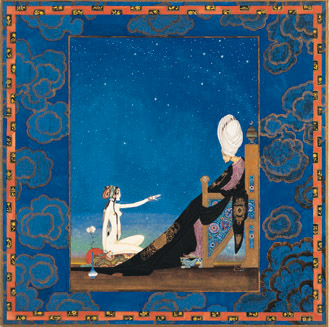
IOT - Arabian nights

As a subject, the tales of 1001 nights, both as far as their content as what is their history concerned, are ideal for In Our Time. Not even a nervous guest such a Gerard van Gelder, Laudian Professor of Arabic at the University of Oxford, a Dutchman?, can ruin that. The tales are fantastic, their history is. And the way they are received by the west is filled with romanticism and fascination with the exotic orient.

It turns out, Arabic high culture is a bit less impressed. The tales are not of good language and considered to be mostly boorish and pulpish. What is more, is that it is anonymous - and that is not looked well upon. In spite of that all, the Arabian Nights is what entered into western culture out of the Arabic. And where did the Arabs get it from? An important question, as the Nights are a product of a lengthy tradtion.

IOT doesn't give a definitive answer, but what begins to emerge is a picture of constant cultural reception and exchange. How old Indian tales are received among the Persians, who give it its initial frame (with the princess Scheherazade) and then the tales of Baghdad. The earliest sources are already Arabian, from the early 9th century, but what makes it to Europe is the 15th century version which already received Turkish elements with gunpowder and coffee. The greatest irony is that because of the Western acclaim, the Nights are re-evaluated among Arabs. And so, out of a long tradition from east to west, the tales are now beginning to run eastwards back. And in any case are a wonderful witness to cultural diversity and exchange.