Monday, October 8, 2007

Hannibal Barca on the couch

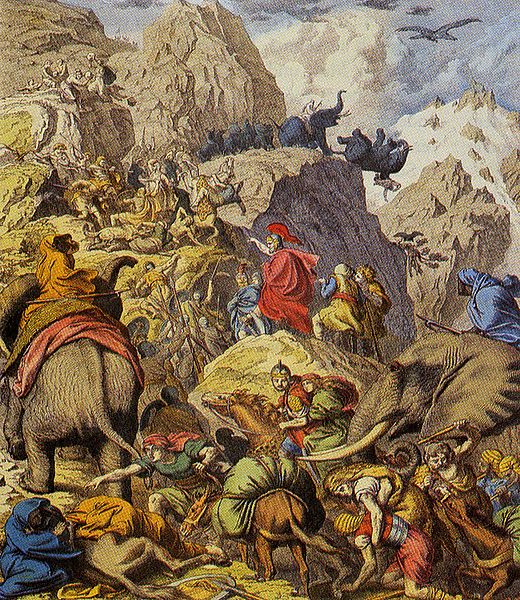
"Why, Mr. Barca," Dr. Patrick Hunt asks, "did you have to cross the Alps?" Why did he hate the Romans? Why did he have to go around them across the highest mountains in the region? Dr. Hunt takes us from a formative experience in young Hannibal's life, through the religion and culture of the Carthaginians in order to explain. Hannibal was taught to hate the Romans with a religious fervor and induced in believing to be blessed on the mountains.

On the altar of the Carthaginian god Baal, young Hannibal had to swear he would hate the Romans throughout his life. This oath made a great impact, because Hannibal knew, normally he would have been sacrificed to Baal, as was customary. In stead he lived. He also lived as Hannibal, Chani-Baal, the grace of Baal. He lived, as it were, on borrowed time, only on the condition of hating the Romans.

Baal, was supposed to live on a mountain. He was supposed to throw lightning, Barca, Hannibal's family name. So, by the grace of his God, on a life quest to fight the Romans, Hannibal could only feel the intimate connection with Baal. Hence, if Baal was at home in the mountains, so was Hannibal. The Romans, by contrast, a propos, were not, they were plain people. Their weaknes lay from the Alps, and Hannibal felt his strength was there. He had to prove it to bout. And that is why he had to take on the Romans and he had to go the long and hard way, right through the high mountains.

Go and look for these lectures on Hannibal on iTunes U, Stanford.

David van Nuys invited by students

Shrinkrapradio's Dr. Dave took a three hour drive up to San Joaquin County in order to speak for a psychology club at the local college. He was invited there by a listener to his podcast and met with a host of some 50 students who follow the psychology courses offered. The interaction with the group was taped and brought out as an episode in the shrinkrap series. This could have been terrible listening, but not so.

It is witness to the great radio talent of Dr. Dave together with his interview skills that it is actually great to listen in on the conversations. One really feels to have been present. What is a great strength of David's is that he neither tries to impress nor please his audience. He conducts himself quite naturally and balanced making for a pleasant focal point skipping from one student to the next for a short exchange. He also has a knack for taking their point, delivering a short answer and hand a return question that is pointy and brief and inviting an answer, neither dismissive, nor short nor too lengthy.

The fact that he truly connects with his audience is shown at several points where he unknowingly touches exactly on that point that is of interest to the student. Like when he tells about child psychology, only to find out that for the student who asked the question this is exactly her main interest. He is struck by it himself and makes a remark about it, but if one listens carefully more such connection points can be detected. Hence, the show turns into an experience I am glad to have had and that underlines once more what a unique and warm podcast Shrinkrapradio is.

Sunday, October 7, 2007

While in the middle of the series

I would like to update the regular readers of my blog, of what is going on. I used produce more reviews, so why so little these days? Part of the explanation are the holidays, which kept me occupied away from the computer on family values. Looking back, however, I can see enough listening time, I managed to put in, but none of that has become definitive. I am in the middle of going over a number of series of podcasts, none of which has given reason to make an intermittent post. So normally I am waiting for a conclusive post after the end.

However, on two series, that are nice to follow more or less simultaneously, I would like to point out, at least, how much I enjoy them, while being in the middle. One is Berkeley's History 4A (The Ancient Mediterranean World) and the other is from Stanford and this is a lecture series by Thomas Sheehan about the historical Jesus. (To be picked up in iTunes through Stanford on iTunes U)

What both courses do for me is reorganize whatever I knew of the ancient history of the region I live in and disconnect it from the religious predisposition of my knowledge and reorder it on the basis of what is the scientific consensus as we speak. Not only by handing the facts, but also by showing the process through which we come to this history. This is particularly rewarding as it demystifies the story and delivers to me the reconstruction without all the added dogmatic meanings.

Tuesday, October 2, 2007

The art of coherence

Paula B of the Writing Show, invited author Daniel Arenson to speak about writing fantasy. Arenson has written and published in several media and has recently brought out his first fantasy novel Firefly Island. It is the story of a land ruled by a king turned to stone and his nemesis, the minor girl, who just happens to posess the magic to challenge him. Arenson has adeptly taken on the genre and in the words of Paula, shown a very deep understanding of writing.

Arenson shows also a deep understanding of interview and under this shower of compliments and the ensuing large questions of writing, composition and publishing, he remains cool, calm and collected. What strikes me most is how he is very focussed and never during the interview strays even a millimeter from what he has to say. At times you even feel he might be in charge and he directs the transitions rather than Paula.

On his website, the first chapter of the novel can be read and here he shows a similar quality. He is very true and loyal to the fantasy genre, the tone of voice that fits to it and the choice of setting, character and use of language that naturally entails the field. Yes, indeed, this is sheer talent we see. If it is not entirely to my taste, it is maybe because I feel not enough challenged and feel that maybe Arenson hasn't challenged himself enough. Surely that should not bother him. He very coherently sticks to his tune and that is a craftsmanship that forms the major part of artistry. What frivolous, avant-garde, provocative side of artistry he is capable of, we must find out by closer inspection.

Monday, October 1, 2007

Where did Hannibal cross the Alps?

Stanford's history podcast (see Stanford on iTunes U) has a great lecture by Patrick Hunt about his quest for finding the exact route Hannibal took across the Alps. In 218 BCE Hannibal evaded a Roman force marching from the Mediterranean coast by turning inland up the valley of the Rhône. His exact route over the Alps has been the source of scholarly dispute ever since ancient times. Since 1994, the Stanford Alpine Archeology Project has explored, excavated and conducted first-hand archaeological research in the Alps.

By now, Patrick Hunt has a pretty good idea where the exact passage might have been. Such a large army passing will certainly have left their traces and he is intent, with the help of national Geographic, to try and prove his theories. The lecture is a very exciting account how he got to his conclusions. The only barriers between now and the moment of either corroboration or refutation are bureaucratic. An archaeologist can't take a grain of sand without permits. So far he has worked with survey permits, the next step is to be able to take samples and start digging.

46 podcasts reviewed

UPDATE: we now have 249 podcasts reviewed. (link)

In alphabetical order all podcasts I reviewed,last post date and relevant labels:
  1. 12 Byzantine Rulers, 30-09-07, history podcast
  2. Bike Radar, 16-07-07, tour
  3. Bio-ethics podcast, 24-09-07, science, law and society
  4. Biota Podcast, 24-06-07, science
  5. Bommel Hoorspel, 01-07-07, NL radio
  6. British History 101, 01-06-07, history podcast
  7. CFR Podcast, 03-08-07, law and society
  8. Dan Carlin's Hardcore History, 11-09-07, history podcast
  9. David Kalivas' World History, 24-05-07, history podcast
  10. From our own Correspondent, 24-07-07, BBC
  11. Haring Podcast, 31-05-07, NL radio
  12. History 167B, 03-Sep-07, Berkeley history podcast
  13. History 4A, 03-Sep-07, Berkeley history podcast
  14. History 5, 03-09-07, Berkeley history podcast
  15. History according to Bob, 25-06-07, history podcast
  16. History Network, 22-07-07, history podcast
  17. In Our Time, 30-09-07, In Our Time BBC (science) history podcast
  18. Interview Vrijdag, 12-07-07, NL radio
  19. ITV, 16-07-07, tour
  20. Jung Podcast, 27-06-07, psychology
  21. KMTT, 02-07-2007, יהדות
  22. Marathon Interview, 30-09-07, NL radio
  23. Matt's Today In History, 26-07-07, history podcast
  24. Military History Podcast, 27-06-07, history podcast
  25. National Archives Podcast, 29-05-07, history podcast
  26. Only in America, 24-05-07, history podcast יהדות
  27. OVT, 20-09-07, history podcast NL radio
  28. Oy Mendele!, 30-06-07, יהדות
  29. Physics for future Presidents (Descriptive Physics), 09-07-07, Berkeley science
  30. Philosophy 103, 28-06-07
  31. Prosperity show, 01-08-07
  32. Rav Dovid's, 02-07-07, יהדות
  33. rpgmp3, 21-06-07
  34. the Skeptics' Guide to the Universe, 06-09-07, SGU science
  35. Šimek 's Nachts, 12-09-07, simek NL radio
  36. Sonic Society, 23-09-07, creative writing
  37. Shrink Rap Radio, 25-09-07, shrinkrapradio psychology
  38. Stanford U, 20-09-07, history podcast
  39. TdF London, 27-06-07, tour
  40. The Word Nerds, 16-09-07, TWN language
  41. University Channel Podcast, 24-09-07, science
  42. Volkskrant Podcasts, 25-07-07, tour
  43. Wise Counsel, 20-09-07, Wise Counsel psychology
  44. the Writing Show, 23-09-07, Writing Show language
  45. Wynyfryd's meditation room, 24-07-07
  46. zencast, 02-07-07
If you know of interesting podcasts that you think should be reviewed, pleas let me know through the comments page.
Thanks in advance,
Anne Frid de Vries