Tuesday, November 20, 2007

OVT - Monarchen, Duitsland, revolutie en ballingschap

OVT had op 18 november een keur aan onderwerpen die het allemaal verdienen voor het voetlicht gehaald te worden. Er was de Salon in Europa, waarbij naar aanleiding van het jaartal 1906, gesproken werd over de monarchieen van Europa, waarbij mijn aandacht, zoals gebruikelijk, vooral uitging naar Duitsland, maar waarbij Engeland en natuurlijk het oude Oostenrijk niet vergeten worden. Een charmante column van Cox Habbema, sluit aan bij het monarchenonderwerp.

Daarna gaat het over het Pannerdensch Kanaal, de economische, ecologische en militaire betekenis; over De Bontekoe, van historie, tot jongensboek, tot publieksfilm en ten slotte het tweede deel waarin Francisca Fangiday vertelt over haar leven (deel een was vorige week). Dit is het persoonlijk verhaal van een eenzame vrouw, verscheurd en heen en weer geslingerd in imperialisme, dekolonisatie, koude oorlog, culturele revolutie, asielzoeken en de problematiek van Derde Wereld autocratie. In een notedop.

Internet gevaren - De ochtenden aan tafel

Misschien als je vandaag een abonnement op de podcast neemt, dat hij niet meer 'Interview op Vrijdag' heet. De rubriek van het radioprogramma De Ochtenden dat de VPRO als 'Interview op Vrijdag' in podcastvorm aanbiedt, wordt nu aangekondigd als 'Aan tafel' en dat verklaart dat het niet zozeer een interview is, als wel een gesprek aan tafel over een aantal onderwerpen, met meerdere gasten. Elke gast met zijn eigen onderwerp, maar met de gelegenheid om over het onderwerp van de ander mee te praten.

Aan tafel, afgelopen vrijdag, zaten onder meer Karin Spaink en Kitty Nooij, met hun aan elkaar gewaagde onderwerpen en uitgangspunten. Spaink krijgt de gelegenheid om ons te waarschuwen voor de afkalving van onze burgerrechten met de komst van het internet. (En misschien, al wordt dat niet met name gezegd, niet alleen met de komst van het internet, maar ook de terrorisme-angst.) Ze komt met data om aan te geven hoe gemakkelijk we electronisch te volgen zijn en hoeveel meer en meer zowel overheid als bedrijven deze gegevens opslaan, raadplegen en koppelen.

De andere kant van het verhaal komt van Kitty Nooij die als officier van justitie deze gegevens nodig heeft en meen dat ze het goed met de burgers privacy voorheeft (ze klinkt zo paternalistisch als ik het nu opschrijf). Haar invalshoek is de strijd tegen de kinderporno. De vraag komt aan de orde of virtuele kinderporno ook als zodaig aangemerkt moet worden en strafbaar gesteld. Spaink zet vraagtekens en Nooij wacht op een eerste rechterlijke uitspraak in een aanhangig proefproces.

Monday, November 19, 2007

Parental alienation - Wise Counsel

What is wisdom? Wisdom is the unnecessary identification when you study psychology, or listen to a psychology podcast for that matter. Dr. David van Nuys spoke with Amy Baker on Wise Counsel about parental alienation. I thought I recognized some behavior of my divorced parents, I thought I recognized some of the bad effects of the Parental Alienation Syndrome on myself. Apart from the hypochondriac element, I notice, one has to be careful and not slip into this mode lest one finds yet another exterior phenomenon to blame for certain deficiencies in our lives. Oh how convenient to have some other person, or some syndrome to blame!

But seriously, from my personal observation, parental alienation is a pretty common occurrence. Even if it does not turn into the outright syndrome, the extreme effects Ms. Baker describes, it may help to identify certain behaviors of our parents, the effect they had and to do away with them. Or, alternately, identify the behavior of our spouses (Praise, the lord, none of that I have) and learn some practical pointers to counter.

Hence, Wise Counsel succeeded, once more, to strike a chord. It is a great podcast and Van Nuys is the genius to bring this about. Dr. Dave the psychologist turned podcaster, what contribution to valuable content, and, I hope, the sanity of us all. Please listen.

Sunday, November 18, 2007

Oxygen - IOT

BBC's In Our Time dove into the history of Oxygen, or rather the discovery of this gas. Could it be claimed by the English (Priestly) or the French (Lavoisier) - a competition that reminds me of the decoding of the the Rosetta Stone. Or should we, maybe for diplomacy's sake, credit the Swedish (Schelle)? Lavoisier ended with a kiss from madame Guillotine and Priestley went bankrupt and fled to Pennsylvania. The end of Schelle was not mentioned.

A truly interesting aspect of this show was the watershed between two different kinds of chemistry. Chemistry as we know it today is all about compounds and elements and as such is very analytic and I'd say, naturalistic. People like Lavoisier are credited from developing chemistry to this kind of a discipline, but at the time, elements were not known and a thinking style wasn't directed at elements. Priestly serves as an example; he was a man who thought in principles. Principled chemistry is less analytic and much less naturalistic. Priestly ascribed to it near mystic qualities; chemistry could be an agent in identifying the good from evil.

In Our Time is a radio program and it is broadcast live. Again, we felt the consequence of this characteristic by the late arrival of one of the guests. Fortunately for IOT, this guest ably adapted to the program and there was no dragging effect. At times that could be different. It goes to show how the traditional way of communicating audio content (radio) is more vulnerable than through the internet, notably through podcasting.

Religious Words

In the latest edition of the Word Nerds Dave and Barbara Shepherd discuss religious vocabulary that is featured in profane language. They relate how an evangelist is any bringer of good news, not just the gospel. A bible has become any kind of heavily thumped handbook, or reference guide. Needless to say, the references are mostly Christian, though I could have thought of some others. Next to paradise we could have had Mecca in a similar meaning; some place being the ultimate spot for a certain experience.

The rude word of the week (every three weeks an episode and still a word of the week) section dives in to all the connections with Holy: as in Holy Cow, Holy Moses and so on, till the PG 13 rating is warranted. Holy cannoli!

Just as they pointed out: the use of religiously associated words sort of erodes the load. I can see this especially clear if I literally translate some common Hebrew, rather day-to-day phrases in secular Israel into English or the even more secular Dutch. If you ask someone 'What's up', in Israel, you may get, even from secular people, an answer that is the equivalent of: Praise the Lord, or: God be blessed. It doesn't make you sound half as orthodox and observant as it looks.

Saturday, November 17, 2007

Ten discoveries that rewrote history

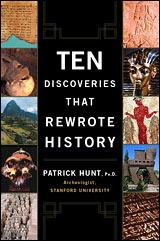
We know Patrick Hunt from his lectures about Hannibal for Stanford on iTunes U. Aside his major investigations on Hannibal and his tenacious quest for identifying the exact route Hannibal took over the Alps, Hunt also serves as a great promoter of archeology in general. He is connected with National Geographic, which will be the first to report any spectacular findings Hunt will make in the Alps between France and Italy.

A great promotion for archeology in general is his latest book Ten Discoveries that Rewrote History, which is aimed at the wide public at large. It takes the reader through ten major archaeological discoveries: the Rosetta Stone, Pompeii, Nineveh, Troy, King Tut's Tomb, Machu Picchu, Thera-Akrotiri, the Dead Sea Scrolls, Olduvai Gorge starting with the Leakey Era and the Tomb of the Ten Thousand Warriors in China. Hunt describes how the discoveries were made and why they had such great impact on our historiography.

Hunt personally sent me a copy of his book, after I mentioned his lectures on this blog. Now that I have read the book, I can recommend it warmly. Especially for those who are not terribly familiar with the related histories.