 I have complained in the past about the way Stanford offered their audio. What is still true is that you still have to go to iTunes U, but my main critique has turned obsolete. I do not know when exactly this was changed, but today I found out that in addition to a button 'get tracks', you now also have the possibility to 'subscribe'. So now Stanford content has been syndicated and can truly be called podcasts. As far as content was concerned they always ranked among the best with amazingly good series such as Historical Jesus and Hannibal. Now I am off to listen to my new find: Geography of World Cultures by Martin W. Lewis.
Tuesday, November 27, 2007
Stanford on iTunes U
I have complained in the past about the way Stanford offered their audio. What is still true is that you still have to go to iTunes U, but my main critique has turned obsolete. I do not know when exactly this was changed, but today I found out that in addition to a button 'get tracks', you now also have the possibility to 'subscribe'. So now Stanford content has been syndicated and can truly be called podcasts. As far as content was concerned they always ranked among the best with amazingly good series such as Historical Jesus and Hannibal. Now I am off to listen to my new find: Geography of World Cultures by Martin W. Lewis.


Engaging in the path - zencast
 In the latest audio Dharma by Zencast, Gil Fronsdal holds a talk with the title Engaging in the path. Following the path is, according to the Buddha, not for the lazy, ro should that be translated into 'for the industrious'? Fronsdal proposes there are a multitude of paths and wonders how one can have the faith, or the conviction, to engage fully into one, the apparently right one.
There is a certain risk and he reminds his audience of a saying: Ships are safe in the harbor - but they are not built for lying there. Hence, engaging in the path involves taking the leap and embark anyway. While being underway one can and must adjust, choose, to stick or to divert, to deepen or to broaden. There is no one right answer. Fronsdal focuses on one of two views: when going on a mountain trek, what is the right approach to the path? Is it all about the target of the journey, or is it about the process?
He insists one cannot do without the other. When one moves, one must have a sense of goal, one must strive to get somewhere - it is too easy, to diverse to stick with the process alone. Yet, when this is all about goals, what when the goal is reached? Sit back? Or rush to the next? What if it is not? One big failure? One must see what is happening all the time; one must commit to contributing to the journey along the path. Well, that is how I put it in my words.
OVT en 1914
 In de serie afleveringen van OVT naar aanleiding van In Europa, was het natuurlijk onvermijdelijk om het over de Eerste Wereldoorlog te hebben. De voorgaande afleveringen, die eigenlijk over de geschiedenis voor 1914 moest gaan, lukte het al niet om aan deze oorlog te ontkomen, maar in de aflevering van afgelopen zondag, die over 1914 ging, moest de kwestie echt centraal komen. De oorlog begon als 'De derde Balkanoorlog', maar loopt al heel snel uit de hand tot een wereldoorlog en de vraag wordt opnieuw gesteld: door wie? Door wat? Behalve de potentiele schuldigen en oorzaken, wordt ook het idee van de onhoudbare ontwikkeling aangestipt.
Voordat een definitief antwoord zich begint af te tekenen gaat het over de vaak onderbelichte wreedheden van de oorlog. Het gaat binnen de kortste keren over de loopgravenoorlog, maar voor de verandering worden de moorden van de Duitsers op burgers in Belgie en Frankrijk naar voren geschoven. Die wreedheden werken op het moment zelf als motor van de oorlog, als rechtvaardiging en motivatie voor de geallieerden. Na de oorlog, leeft men in de schok en sloeg om naar pacifisme en wilde de oorlog gaan afschilderen als een grote absurditeit die eigenlijk nergens over ging. In die weergave kregen de verhalen over de wreedheden de smaak van propaganda en hoogstens een opgeblazen versie van werkelijkheid.
Toch blijft de motivatie, vooral de motivatie tot en met 1918 aan toe een merkwaardige kwestie. Zowel de motivatie van de soldaten, maar ook de rationaliseringen van leiders - waarom ging men maar door? Waarom kon men niet stoppen? Over de Eerste Wereldoorlog zijn we nog niet uitgepraat, ook OVT nog niet.
One for the books - On The Media Podcast
 A recommendation from Open Culture is always worth following. Contributor Ed Finn pointed to the radio program from New York Public Radio (WNYC) On the Media. On The Media is also published as a podcast. The program is presented by Brooke Gladstone and Bob Garfield and sits in the taxonomy News & Politics (iTunes Genre), but this episode was about books.
Books are by far the most successful media, but as we publish more and more content digitally, does this mean books will go out of print? The new development of electronic readers (notably the Kindle), will bring books to our hands without paper. And we have already abandoned newspapers, for reading news on line. Besides; wouldn't that be really great for forests, for the environment, if we did away with paper?
However, by offering parts of books (sometimes whole books) digitally and for free, publishers are still managing to sell more books. It is such a great pleasure, and maybe a need, to have a book, the paper, actually in your hands, nobody seems to want to give up on it. Digitally, we can have any book, any time, anywhere, available, but if we still want it in our hands... It turns out, a machine has been developed to supply this need with instant print. Great podcast episode.
Monday, November 26, 2007
Parashot haShavua
KMTT offers nearly every week a 30-45 minute lesson about parashat hashavua. Last week we had parashat vayetze - when Jacob meets Rachel at the well and we understand this is the woman he is supposed to marry. Parallels are seen with Eliezer's quest to find a bride for Isaac, and met Rebecca at a well, as well. There is much emulation going on between the generations as already noted before.
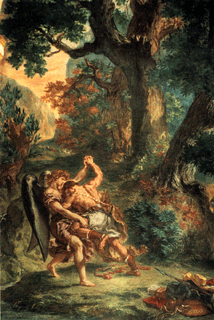 This week's parashat vayishlach, contains the story of Jacob wrestling with the angel and left wounded. He was fleeing from Esau and I had always had a feeling Esau had something to do with this nightly fight. Rabbi Chanoch Waxman points out that some interpretations to the story indeed suggest that this angel is in a way an emissary from Esau. But suppose it is God's angel, what would be the meaning of the struggle? The effect by all means is Jacob cannot flee from Esau and he has to stand up in front of his brother. Another effect is his new name: Israel. In a way Jacob acquires a new identity. One who no longer flees, or wriggles and schemes, but rather a strong man who can stand up before men. Here he becomes the forefather.
Listen to the podcast in order to find out how Waxman construes the argument. I couldn't help savouring the thought of a banality enriched with Greater Meaning. Jacob is afraid of his brother and tries to flee. During the flight he gets injured on his leg and cannot continue, therefore has to face his plight. In order to deal with the question what would be the meaning of all this, the struggle with the angel is invented. It is a way of looking at life. Not taking any banal coincidence as just that, but always searching for a deeper meaning.
This week's parashat vayishlach, contains the story of Jacob wrestling with the angel and left wounded. He was fleeing from Esau and I had always had a feeling Esau had something to do with this nightly fight. Rabbi Chanoch Waxman points out that some interpretations to the story indeed suggest that this angel is in a way an emissary from Esau. But suppose it is God's angel, what would be the meaning of the struggle? The effect by all means is Jacob cannot flee from Esau and he has to stand up in front of his brother. Another effect is his new name: Israel. In a way Jacob acquires a new identity. One who no longer flees, or wriggles and schemes, but rather a strong man who can stand up before men. Here he becomes the forefather.Listen to the podcast in order to find out how Waxman construes the argument. I couldn't help savouring the thought of a banality enriched with Greater Meaning. Jacob is afraid of his brother and tries to flee. During the flight he gets injured on his leg and cannot continue, therefore has to face his plight. In order to deal with the question what would be the meaning of all this, the struggle with the angel is invented. It is a way of looking at life. Not taking any banal coincidence as just that, but always searching for a deeper meaning.
Sunday, November 25, 2007
Adventure as therapy
A prejudice I easily slide into, and probably many others with me, is to think of psycho-therapy as activity that involves a couch, a comfy chair and a lot of talk. Therapy, even though it must be all about our emotions, working out as a fundamental cerebral activity. Dr. David van Nuys's podcasts can teach us otherwise. We have already had an issue about art therapy to give but one example. On further thought: every therapist, even when taking the talkative approach knows how to tap into the more emotional and intuitive layers of the client, for any kind of success. Art can be such a great method to let people speak their minds, without too much control of their rational brains.
 The latest interview on Shrinkrapradio hands yet another example of such an approach: adventure based psycho-therapy. Therapist Jason Holder takes his clients into the outdoors. Fishing, kayaking, climbing and swinging ropes, climbing walls, they can exercise their hearts content. Thus he makes them confident, builds a good relation with the client, with trust and respect and then the setting is right to get the issues out. Especially with children and adolescents, this approach is working really well.
Jason has published on the subject and represents one of the few who has made information about using the outdoors in a therapeutic way available to the public and the profession. I hope his and other material can be combined into some good studies. I recall Dutch therapists having taken problematic youth on survival trips in the Ardennes (Belgium) in the eighties and nineties. Not always with 100% success, but that is not the point; hasn't this been documented? The basis of the approach seems so obviously sound, there has to be ways to work them out.
The latest interview on Shrinkrapradio hands yet another example of such an approach: adventure based psycho-therapy. Therapist Jason Holder takes his clients into the outdoors. Fishing, kayaking, climbing and swinging ropes, climbing walls, they can exercise their hearts content. Thus he makes them confident, builds a good relation with the client, with trust and respect and then the setting is right to get the issues out. Especially with children and adolescents, this approach is working really well. Jason has published on the subject and represents one of the few who has made information about using the outdoors in a therapeutic way available to the public and the profession. I hope his and other material can be combined into some good studies. I recall Dutch therapists having taken problematic youth on survival trips in the Ardennes (Belgium) in the eighties and nineties. Not always with 100% success, but that is not the point; hasn't this been documented? The basis of the approach seems so obviously sound, there has to be ways to work them out.
Subscribe to:
Posts (Atom)