Thursday, September 20, 2007
UC podcast tries to laugh (humour)
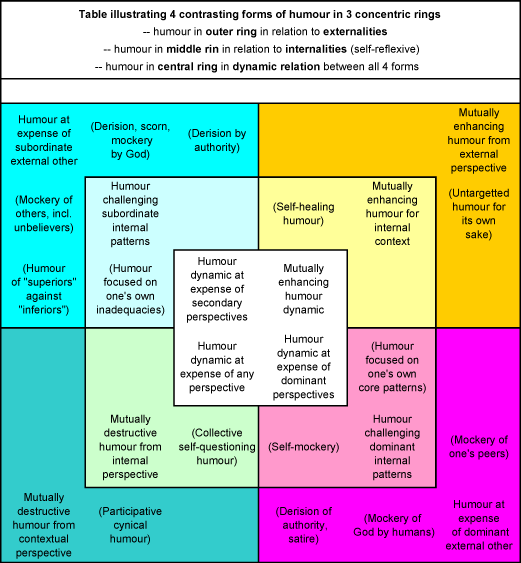
A rather unexpected and compelling title occurred in the feed of the University Channel podcast: Only Joking - how humour makes us human. Usually the lectures in this podcast are, if entertaining, still very serious and pretty heavy. Not this time. While our sense of humor is being explained as a defining human trait, lots and lots of jokes are made. Sometimes they are funny just for being seriously recited with scientific claim to pun and then turn out to have little to offer at all. Especially the alleged jokes from Macbeth and other classics. It reminded me of over-enthusiastic reverends trying to show off with a joke from the Bible. Face it, the Bible is not funny, not intended to be funny, it is only funny when poked fun at, especially because it is not funny. That's what I think, or did I miss the joke?


The Writing Show - Audio Plays
 The Writing show comes with a refreshing suggestion: try your hand at writing audio plays. An excellent idea. Audio plays are easier to produce and offer an template for a lot of dialog. Dialog usually forms the backbone of my narratives. What is more, I used to like audio drama. Such good memories I have about Draußen vor der Tür by the impressive Wolfgang Borchert.
As usual, the writing show knows how to inspire me. Much of what is discussed delivers a lot of good practical advice. I hope the sound clips also help. In any case, this podcast has induced me, checking out on the Sonic Society. However, I must admit, the clips were not exactly to my taste.
Plenty of material to work with though. And a sound excuse to read Borchert again. Not just Draußen vor der Tür, there are more plays. And there is the short and pungent An diesem Dienstag, which mesmerized me already in 1982.
OVT - Meindert Fennema, Plasterk en M.K.
Via de website van OVT kan je de verschillende onderdelen van het programma in afzonderlijke streams beluisteren. Als dat toch al kan, waarom wordt de podcast van OVT zonder enige vorm van post-produktie in de feed gezet? Waarom niet die tien minuten over Mein Kampf in een aparte file, of anders afdoende gemarkeerd met een bookmark? En zonder die overbodige minuten met flarden van commercials en nieuwsbulletins? Het leidt ertoe dat ik OVT meestal niet ophaal, laat staan beluister. Jammer van zo'n goed programma.
 Deze keer heb ik dus wel geluisterd. Na alle ophef in Nederland, eerst met Geert Wilders' hete luchtballon om de Koran te verbieden en vervolgens - als tegenreactie, kennelijk - minister Plasterk die Mein Kampf maar weer wil toestaan. En daar dan vervolgens half en half op terug moet komen. Over dat laatste gaat OVT en we gaan meteen naar de oorsprong: politicoloog Meindert Fennema, die al in de Volkskrant schreef dat MK eigenlijk wel weer moet worden toegelaten in Nederland.
Waarom eigenlijk? Omwille van de vrijheid van meningsuiting, natuurlijk, maar hoe zit het met de beperking daarop? MK is verboden als haatzaaiend (woord?) boek. Daarom wil Wilders de Koran ook verbieden; omdat het haatzaaiend zou zijn. Een ander argument dat over tafel gaat is het verband tussen het boek en de moord op talloze mensen. In die gedachte zou je de Bijbel ook kunnen verbieden. Ten slotte wordt de specifieke, emotionele en symbolische lading van MK haast zijdelings aangestipt. Daar gaat het mijns inziens juist om de kern van de rechtvaardiging voor het geldende verbod, maar dan zijn de tien minuten voorbij en haast OVT zich naar het volgend onderwerp.
 Deze keer heb ik dus wel geluisterd. Na alle ophef in Nederland, eerst met Geert Wilders' hete luchtballon om de Koran te verbieden en vervolgens - als tegenreactie, kennelijk - minister Plasterk die Mein Kampf maar weer wil toestaan. En daar dan vervolgens half en half op terug moet komen. Over dat laatste gaat OVT en we gaan meteen naar de oorsprong: politicoloog Meindert Fennema, die al in de Volkskrant schreef dat MK eigenlijk wel weer moet worden toegelaten in Nederland.
 Waarom eigenlijk? Omwille van de vrijheid van meningsuiting, natuurlijk, maar hoe zit het met de beperking daarop? MK is verboden als haatzaaiend (woord?) boek. Daarom wil Wilders de Koran ook verbieden; omdat het haatzaaiend zou zijn. Een ander argument dat over tafel gaat is het verband tussen het boek en de moord op talloze mensen. In die gedachte zou je de Bijbel ook kunnen verbieden. Ten slotte wordt de specifieke, emotionele en symbolische lading van MK haast zijdelings aangestipt. Daar gaat het mijns inziens juist om de kern van de rechtvaardiging voor het geldende verbod, maar dan zijn de tien minuten voorbij en haast OVT zich naar het volgend onderwerp.
The historic meaning of 1910
Technically, this is not about a podcast. As I pointed out below, there is a new section in iTunes, called iTunes U, which contains audio material from universities, and as such they can be downloaded and subscribed to, just like podcasts, iTunes simply does not list them as podcasts. As opposed to Berkeley, that uses both iTunes U and podcasting, Stanford, is only into iTunes U. And so, what I would call their history podcast, it cannot be acquired through any regular feed, other than iTunes U and also, will not show up in your player as podcast, but rather similar to all other audio material.
 That aside, this Stanford history podcast, is a kind of radio program in which one or more professors discuss a certain subject in history. The show I have listened to was about the year 1910. By means of art and cultural typifications, 1910 is shown to carry all the marks and indicators of what disasters that are about to come. The Great War and all that was triggered by the Great Wat in turn, the second World War and the Cold War.
The two professors Harrison (they are brothers) go about this fantastic subject in a bit of a tentative way. There do not seem to be much order and programming. There is even an interruption, that has nothing to do with the program altogether, rendering it a bit amateurish. A pity, because it diminishes the depth of the subject and the quality of the speakers.
That aside, this Stanford history podcast, is a kind of radio program in which one or more professors discuss a certain subject in history. The show I have listened to was about the year 1910. By means of art and cultural typifications, 1910 is shown to carry all the marks and indicators of what disasters that are about to come. The Great War and all that was triggered by the Great Wat in turn, the second World War and the Cold War.The two professors Harrison (they are brothers) go about this fantastic subject in a bit of a tentative way. There do not seem to be much order and programming. There is even an interruption, that has nothing to do with the program altogether, rendering it a bit amateurish. A pity, because it diminishes the depth of the subject and the quality of the speakers.
Why is iTunes U in music and not in podcasts?
 There is a new section in the iTunes directory, that is called iTunes U.
  It is a section where universities (so far only American Universities are present) can publish their audio material. We can safely assume - and a couple of samples I have taken indicate exactly at that - most if not all of this material is educational material, whether they are lectures, interviews, talk radio, panels and so on. From my perspective, this section qualifies as educational podcasts and the content is exactly up my alley.
 Not only does it walk and talk like educational podcasts, the fact that the material is free and can be subscribed to, also gives it the attributes of podcasts. That is where we hit a snag. iTunes does not treat this material as podcasts. Upon download, it is placed in the music library, inconspicuously between all the rest of the material. There is no 'podcast' or similar label and neither is it copied into the podcast section. The only separation is a folder with playlists. (I took some stuff from Stanford, so I have a Stanford folder now)
 I do not like this taxonomy at all. iTunes should treat all podcasts as podcasts. It would be great if actually all talk material would be separated from the music, podcast or otherwise. Next, it would do, to have this talk section be customizable, so that the user can devise a taxonomy of his own. This woukld also improve the podcast section, which, at the latest version, still has a flat hierarchy, listing all of my podcasts, one after the other, without allowing me to group them in any which way. With the amount of podcasts I keep at hand, this has become near unmanageable.
EDIT: Have Stanford or iTunes officials been reading my blog? Stanford and other universities on iTunes U offer a button to subscribe thus making their audio true podcasts. The content turns up in the familiar podcast section. Such an improvement.
Wednesday, September 19, 2007
Rudi Kross -- Marathon interview
 Rudi Kross fulmineert tegen de popmuziek; Rudi Kross analyseert hoe de chaos van Suriname, leidde to moralisme, wat weer leidde tot een suri-fascisme. Van dat fascisme beticht hij de dictatuur van Bouterse, waar hij toch zelf een zekere periode adjudant van is geweest. "Als een burgemeester in de oorlog?" "Ja, als je dat zo wilt noemen." En passant wordt de tour van '89 aan Fignon toegeschreven (achteraf weten wij wel beter) en heet Suriname 'dat ding'. Dat ding dat de Nederlandse koloniaal gebruikt heeft tot hij het niet meer nodig had en toen anderhalve eeuw te laat onrijp de onafhankelijkheid ingeschopt.
Het marathoninterview dat John Jansen van Galen met Rudi Kross heeft in 1989 is een emotionele wervelwind. En een orgie van het bloemrijke taalgebruik, de secure dictie en het onverschrokken zoeken naar de juiste woorden van Kross. De haat-liefde verhouding met Suriname, met Nederland, met Links, met Bouterse, maar zonder te schmieren. Kross zegt het over de Surinaamse cultuur, en daarmee over zichzelf, waarin het zo anders is dan de Nederlandse: het laat de emotie bestaan. (Ik paraphraseer op mijn onbeholpen -Nederlandse?- manier) Het geeft de ruimte voor iets van esoterie, het vreemde, het mysterie, het unieke. Nederlands is het daarentegen - zo stelt hij nadrukkelijk - om alles te vergewonen. "Oh, je bedoelt eigenlijk te zeggen dat .." Te banaliseren?
Zo niet bij de Surinamers, niet bij Rudi Kross, niet in dit avontuurlijke marathoninterview. Waarin zomin het bagatel als de grote zaken banaal worden. Niets wordt vereenvoudigd. De complicaties worden niet uit de weg gegaan. En Kross blijft proberen uit te leggen, te duiden. Het mysterie blijft bestaan, maar de emotie komt over en trilt nog na, diep in mijn botten, ook hier ver buiten Nederland en bijna 20 jaar na dato.
Subscribe to:
Posts (Atom)