Sunday, August 10, 2008

Disaster Capitalism - Naomi Klein on Big Ideas

Naomi Klein spoke on Big Ideas (TVO) in January and I was alerted by a reader to this speech. Klein builds a flaming argument against Capitalism for her Canadian audience, pointing to the neighbor south as where it all happens first and the images are at the ugliest. She also wrote a book about this: The Shock Doctrine; the rise of disaster capitalism.

Look at the Katrina disaster. It just so happened she was in the disaster area and had to be taken to a hospital and in stead of finding herself in an over-crowded, messy public place, she woke up in a crisp and empty private clinic. This shows her point: capitalism divides the world in the haves and the have-nots. And the have-nots have no access to normal services. This is not just true during disaster, this is true all the time.

I'd like to add, this has always been true throughout history, capitalist societies or not. Being richer means being healthier, safer, more certain regarding the future and so on. Richer people can more easily get out of harms way and if they didn't manage to do so, they have the means to recover faster and more completely.

The point is: Disaster Capitalism has no problem with that. The ideology of the US is that you should invest in the proper means to protect yourself and if you didn't then that is your problem - it is not a public issue. And it goes further: disaster, is not a problem, it is a business opportunity. It allows for new commercial possibilities. Klein shows how this regime is closely intertwined with fear. We are ready to buy away our fears, but receive an ugly society in the bargain. She cries out to stop. She begs her audience not to let this happen in Canada.

The lecture is very invigorating, but the thought remains: although this is important, how much of this is accusing what has always been so in the history of mankind.

Previously on Big Ideas:
The bad news about good work,
History.

AddThis Social Bookmark Button

Saturday, August 9, 2008

Sound shifts and umlauts - German Cultural History

The (Medieval) German Cultural History Podcast (related blog, feed) is not an easy listen. Tom, the host, allows himself to get carried away from the script and talk about a tangent that catches his mind. It is never irrelevant, but you have to be able to bear with him. It is frequently about linguistic aspects of Germanic languages. Apparently, for getting German Culture in sight, you have to grasp the basic recognizable elements of the language.

So, in the latest edition (German Medieval Cultural History VII: Merovingians, Carolingians and what makes German distinct) the impression you get is that you are going to get some insight in Frankish history and their leader dynasties, first the Merovingian Kings and then, after Charles Martell, the Carolingians. But we stumble into the technicalities of identifying the German linguistic roots. What almost stays as an aside, but surely must surprise many listeners: the Franks were a Germanic tribe. They gave their name to modern day France, which speaks French, which is not a Germanic language. That is because the Franks turned Roman Catholics, and thus got their cultural influence so heavily from Latin, they latinized.

Other Germanics, if they were Christians, were not Roman Catholics, but Arians, a forgotten style of Christianity, but important enough for the Nicene Creed to be kicked off side. In previous editions, Tom has shed some light on this, for which I am very grateful. Before he got off on linguistics. As this time when he tries to explain about umlauts and sound shifts. I am getting the impression Tom is a linguist, an academic of German Language, I guess. Maybe he should dedicate one issue about systematically dealing with the language, so that his history is not interrupted in such a rambling fashion.

Recently, when I wrote somebody what I liked about this podcast, I summed it up like this. He does everything wrong, but he tells what I want to know and that is why I think he is great.


Previously:
Why Iceland,
German Cultural History - Podcast Review.

AddThis Social Bookmark Button

Friday, August 8, 2008

Five Free Favorites of Jesse Willis (SFF audio)

SFF Audio, the blog about podcasts and other audio that is available about SciFi and Fantasy, invited me to write a couple of guest posts on their blog. This weekend, there will be the first. It will be part of their guest blogger series in which the bloggers tell about their Five Favorite podcasts.

I will write about my favorite history podcasts, which, by the way, is a shifting phenomenon. I'll give a you a different list any other day, but that is not what I wanted to get into. What I wanted to point out is that SFF audio covers intensively a field that I have just touched recently: fictional podcasts.

The main writer on SFF audio, is Jesse Willis. He was kind enough to reveal some of his favorites (five as it happens) in a guest blog over here. Thank you, Jesse!


Hi! I'm Jesse Willis, guest blogging on Anne is a Man. Today I'm going to tell you about some of the cool stuff I listen to. Sure, like Anne I listen to a lot of non-fiction podcasts. And like Anne I'm a big fan of some of the best listens out there. I'm a Dan Carlin's Hard Core History convert. I've been listening to Professor Bob of History According To Bob for years. But I figure you've heard the praises of these terrific shows from Anne before. So let me tell you about some similar shows, shows that will strike you as cool, but which Anne hasn't yet covered:

1. Entitled Opinions is a podcast radio program hosted by Professor Robert Harrison. Harrison teaches in the department of French and Italian at Stanford University. He interviews guests, often other Stanford profs, about literature, history, politics, philosophy and even sports. His shows are deep, cultured and highly literate. Having been born in Turkey as the son of American diplomats, Harrison has an immense knowledge about that country, his interview with historian Aron Rodrigue is enlightening. Similar-wise, Harrision's talks with René Girard on the subject of mimetic desire are perhaps the most fascinating ever podcast. From Virgil to the Virgin Mary, from the historical Jesus to Athenian Democracy; Entitled Opinions, with its braggadocious title, earns it.

2. Two programmes by Shannon Clute and Richard Edwards have obsessed me since they first launched. (blog)

Behind The Black Mask: Mystery Writers Revealed sits down with Crime/Mystery/Noir authors and dissects their work. Clute and Edwards approach each author's work as if it was their doctoral thesis.There has never been an interview series like this. The inteviewees often come away with a new sense of their own work. And The listener comes away with a strong desire to read the books they talk about. I'm hoping that soon they'll be able to interview Donald E. Westlake and Lawrence Block (my two favorite living crime authors). Check out their talks with Christa Faust, Seth Harwood and Charles Ardai.

Out Of The Past: Investigating Film Noir, on the other hand is an examination of films influenced by the Film Noir movement. Most DVD commentaries suck, if Clute and Edwards did film commentaries I'd buy the DVDs just to hear their shot by shot examinations. These are two highly literate Crime/Noir/Mystery fans. Check out their talks about: Body Heat, Kiss Me Deadly and the immortal Pickup on South Street.

3. Professor Courtney Brown's course at Emory University (it's archived) is a Political Science course entitled Science Fiction and Politics (Political Science 190). Brown's lectures are from two semesters of teaching this course and feature incisive political insights found in more than a dozen Science Fiction novels. Science Fiction is the most important of all modern literature because it engages the present with philosophical ideas. Let Courtney Brown illustrate just a few of the political ideas found in SF and you'll stick around for the whole course.

4. Welcome To Mars (1947-1959), is an odd series broadcast on Resonance FM. Creator Ken Hollings collects non-fiction oddments about the fantastic futuristic world of the fifties. This was a live-broadcast twelve-part series - kind of a one man show, with the subtitle The fantasy of science in the early years of the American Century. Hollings: "Between 1947 and 1959, the future was written about, discussed and analyzed with such confidence that it became a tangible presence. This is a story of weird science, strange events and even stranger beliefs, set in an age when the possibilities for human development seemed almost limitless." The show is hypnotic. I'm not sure I learned as much as I unlearned, if that makes any sense.

5 Finally, here's one you'd probably never otherwise see on Anne Is A Man:

Three years into it and I'm still in love with The Red Panda Adventures! (feed) This is an old-style radio drama (along the lines of The Green Hornet) but with modern storytelling and action. Full of kung-fu and snappy dialog you'll love it most for the wonderful characters and their dialogue. If you don't like Red Panda there's something broken in your heart!

AddThis Social Bookmark Button

Thursday, August 7, 2008

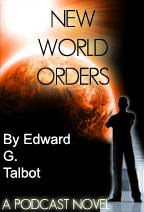
New World Orders - fictional podcast review

More and more people use the report a podcast feature on this blog. Thus, I also found New World Orders, a fictional podcast telling a tale of world wide conspiracy. It is an entertaining ride, but I kept wondering whether this is intended to be a thriller or not. The story is so full of cliches, it could be a satire, but then again, that is not so clear either. The funny thing is, it is exactly this ambiguity that kept me listening.

For one, I was caught enough by the thriller, to want to know what was going to happen next. I wanted to know how the conspiracy works and I wanted to see the lonely hero succeed in his quest against it. Although, he seems so puny in comparison to the invisible enemy and he couldn't brush his teeth without them knowing. And they do not refrain from bribes, threat and murder to get their way.

But secondly, there was the thrill of observing the story and figuring out what the writers and performers are thinking. Are they deliberately going over the top a bit, in order to satirize the genre? And what about this hitman of Austrian descent - he sounds exactly like Arnold Schwarzenegger. Are they thinking of specific movies and actors for their characters? And what of this impersonation of George Bush, the father - that surely is more comical than tensely thriller-like.

So, eventually, this is a great podcast where everybody can have his own preferences served. If you want straightforward entertainment - there is the thriller with the evil schemer and his hidden agendas, with the silenced witnesses, the bribed ones and the lonely few who catch a whiff of something suspicious in the air and who investigate and then find themselves facing the invincible Moloch. If you like conspiracies, there is the question: who would want to cover up global warming? If it is not the big industry that wants to go on polluting, then somebody with long term vision. But what could he gain with a planet going sick? And who is behind the JFK assassination and the blowing up of the Space Shuttle? If you like Hollywood thriller movies, you can play the game of who is who in the story. The coldblooded killer is Schwarzenegger, but who are the rest? If you are struck by the cliches, you can observe the satire, the subtle poking at the over-construed genre.

More narration and fiction podcasts:
Namaste Stories,
Forgotten Classics,
Celtic Myth Podshow,
Librivox,
Sonic Society.

AddThis Social Bookmark Button

Wednesday, August 6, 2008

Namaste Stories - fiction podcast review

Podcast fits for passing any audio, not just interviews, panel discussions or lectures. Thanks to my readers' listening tips, I ventured a little bit more into narration and fictional podcasts. It goes to show, among others, how useful the report a podcast feature on my blog is. And so, I got a listening tip from Julie from Forgotten Classics to check out the podcast Namaste Stories and over the mail I was contacted by the makers of New World Orders. Both will be reviewed on this blog, beginning with Namaste, here and now; New World Orders will follow later this week.

Fictional podcasts magnify the elements of literary use of language and of drama, which includes dramatic use of voice as well as acting - if you can separate that after all. It makes for more intense listening. It adds to the cerebral, intellectual and possibly spiritual aspects, that I know so well from the regulars on this blog. It adds the aesthetic, in sound, language, composition and performance. Consequently, the listening is more intense and demands more concentration. I am used to listen while engaging in driving, shopping, cleaning or other menial tasks. Combining fictional podcast listening with driving or shopping doesn't work out to well. The menial task needs to be more monotonous and routine - like cleaning for instance.

For Namaste I didn't even do that. I just sat down and closed my eyes. DaveP, the maker, provides a total immersion podcast. He makes the music, writes the (very literary) text and reads it, with a restrained passion that is mesmerizing. I have let myself float with the sound experience, tremendously enjoyed the integrated whole and yet, still I haven't figured out whether the stories are independent or part of a larger scheme. They seem to be related however with returning persona's such as Georgette, Dad and I - the narrator. For the joy of the podcast, that is not needed. What we see is podcast as a work of art.

More:
Forgotten Classics

AddThis Social Bookmark Button

Kraaykamp en Berk - Simek podcast recensie

De live uitzending van Simek 's Nachts met Johnny Kraaykamp jr. en Marjan Berk werd een vrolijke aangelegenheid. Vrolijk met een gevoelige touch. De meest sympathieke vorm van entertainment.

Simek vraagt Kraaykamp een mop te vertellen. En Kraaykamp begint met te zeggen dat hij eigenlijk niet zo'n moppentapper is, maar vertelt dan toch. Simek herkent de mop meteen en dan gaat het niet alleen over de mop, die echt een leuke mop is, maar ook over de betekenis, die ik hier niet weg wil geven. Dat is de perfecte wisselwerking tussen Simek en Kraaykamp en die brengt ons ook nog een gevoelvolle lofzang die Kaarykamp jr. op zijn oude vader zingt.

Marjan Berks inbreng is haast nog beter, nog scherper, oprechter en vaak ook onverwacht. Ze is grappig wanneer je het niet verwacht en serieus, wanneer je net in de lichte sfeer gesetteld bent. Dat maakt dat alles heel goed werkt wat ze vertelt. Over haar gescheiden ouders, over de minnaars (zonder jaloezie) van haar moeder en over haar carriere, van de toneelschool via Wim Kan naar haar succes met schrijven.

Meer Simek op dit blog:
Brigitte Kaandorp,
Heleen Mees, Maarten van Roozendaal,
Barbara van Beukering, Gert Dumbar,
Jaap van der Zwan,
Lucie Stepanova.

AddThis Social Bookmark Button