Tuesday, April 21, 2009

Hoor Geschiedenis op iTunes (hersteld)

Voor het weekend meldde ik dat Hoor! Geschiedenis van Feico Houweling op iTunes niet meer aangeleverd werd. Dit probleem is inmiddels verholpen. Alle aflevering zijn weer beschikbaar. Nu kan ik er vijf achter elkaar afluisteren.

Meer Hoor! Geschiedenis:
Plakkaat van Verlating,
Willem van Oranje als Bijbelfiguur,
Dagelijks genoegen: hoor! geschiedenis,
Hoor! Geschiedenis - historische podcast recensie.

AddThis Social Bookmark Button

Monday, April 20, 2009

Disasters and Peace - UChannel Podcast

Some time ago, someone said to me: "The only thing that will give a good turn to the Arab-Israeli conflict will be a great natural disaster. It will show how the Israelis and Palestinians are in the same boat, it will force them to cooperate and this in turn will produce a basis of mutual trust and respect." I was surprised by this idea and at the same time not completely convinced. Besides why must we wait for disaster to strik?

Can disasters have such an unexpected good side-effect? On UChannel Podcast was a lecture by Michael Renner given at NYU Wagner that addressed exactly this phenomenon. Renner uses the 2004 Tsunami as the example disaster and looks at Aceh and at Sri Lanka to see the peace effects. The result is mixed. Somehow on Aceh, peace could be given a new impulse and this development looks sustainable. On Sri Lanka however, although also here the impulse was put in place, the peace process got stuck for lack of political commitment.

If political commitment is a prerequisite for the success, not only is a peace turn out of a disaster no easy result, neither is it one that can be achieved with the right amount of grass roots or external effort. The Sri Lanka case shows how the ruling elite somehow holds a power of veto. It is conceivable that also in the Middle East there are enough political streams that are so profoundly not interesting in peace that a disaster may not change this at all. And then they can sabotage whatever peace developments spring up.

More UChannel Podcast:
Enclosing the commons of the mind,
Middle East challenges,
Good climate for everyone (global warming),
Robots and War,
Sudan and the fallacy of nationhood.

AddThis Social Bookmark Button

Sunday, April 19, 2009

Karel van het Reve - Marathon Interview 1986

Op de een of andere manier was het interview dat Martin van Amerongen had met Karel van het Reve zoekgeraakt in de archieven van de VPRO. Terwijl de overige marathoninterviews uit 1986 reeds lang in de podcast feed en on-line verkrijgbaar waren, was dit interview uitgesloten. Dat is inmiddels hersteld en ik heb met genoegen de volle vijf uur afgeluisterd.
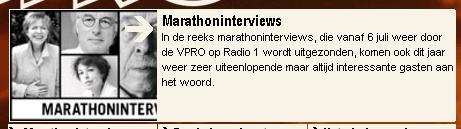
Zowel Van het Reve als Van Amerongen spreken in prachtige volzinnen. Op voorhand is het al een feest van welbespraakt intellect. Nadat God is afgedaan als een soort Idi Amin en Freud als de kwakzalver van Wenen is het tijd voor Van Het Reve's politieke kleur. Hij stemt nog wel PvdA, maar begint naar de VVD te leunen en dit is het signaal voor Van Amerongen om bij elke gelegenheid die zich verder voordoet aan de VVD te refereren als 'jouw partij'. Van het Reve laat zich er niet door uit de tent lokken, waardoor het van villain tot flauw en kinderachtig wordt. In plaats daarvan had ik graag uitgebreider te horen gekregen hoe Karel van communist tot liberaal is geworden.

Waar Van Amerongen de zwakke schakel is, met weinig doorgravende vragen, geen kennelijk plan waarover hij Van het Reve tot verrassende of openhartige uitspraken wil lokken en af en toe wat ongearticuleerd gemompel, is Van het Reve de ster. Is alleen de topkunst echte kunst? Nee hoor. Een slecht mens is ook een mens en dus is een slechte kunstenaar ook een kunstenaar. Ik vind Rembrandt beter dan Poortvliet, maar daarom kan Poortvliet nog wel een kunstenaar zijn. Bovendien, als iemand een Poortvliet aan de muur heeft hangen, weet je zeker dat hij daar van houdt. Met een Rembrandt aan de muur kan het ook zo zijn omdat men denkt dat dat goed staat.

Uit andere bronnen komt Van het Reve naar voren als een man die zich nogal eens verschuilt achter valse bescheidenheid. Alsof hij niets gelezen heeft en nergens verstand van heeft. Dat is in dit interview niet anders. Van Amerongen benoemt dat een paar keer, maar pusht Van het Reve nauwelijks, terwijl dat best gekund had. Van Amerongen zelf verschuilt zich ook, met een toon die ik wat badinerend en ijdel vond. Het was een goede podcast, maar het had een betere interviewer verdiend.

Meer Marathon Interviews:
Jan Montyn,
Arthur Japin, Johannes van Dam,
Mr. G.B.J. Hiltermann,
James Kennedy,
Dick Berlijn.

AddThis Social Bookmark Button

Saturday, April 18, 2009

Brave New World - In Our Time podcast

Thanks to BBC's In Our Time I could learn a bit about that book that everybody else has read and refers to: Aldous Huxley's Brave New World. It is interesting to read in host Melvyn Bragg's newsletter, that although he has read the book, he needed the program also to be informed (again) about it.

"[...] if challenged, I would have nodded and said yes, I know that book. Well, I know the author’s name. I also knew that it involved a state a few hundred years after the death of Henry Ford. I remembered the alphas, betas, gamma, deltas and epsilons. I could call up the incubators and words like ‘feelies’ and ‘soma’ would drift around somewhere. But when taxed [...] to get a grip on it for In Our Time, I discovered how little you retain, even in areas where you have been programmed (now that would have fitted in with Brave New World) to remember."

I hope you have all downloaded the podcast, otherwise you will have to go and listen to the on-line stream, as this issue of In Our Time was broadcast more than a week ago. Last week's isseu was about Suffragism and I still have to listen. If I come round reviewing it, it will by then be no longer available. So the recommendation is as always: download In Our Time as soon as possible.

More In Our Time:
Rafael's School of Athens and the depiction of Plato and Aristotle,
The Boxer Rebellion,
The library of Alexandria,
The Waste Land by T.S. Eliot,
The destruction of Carthage.

AddThis Social Bookmark Button

Friday, April 17, 2009

Hoor Geschiedenis op iTunes

De podcast Hoor! Geschiedenis, van Feico Houweling, is sinds enkele dagen uit de lucht. Er zou elke werkdag een nieuwe episode moeten zijn, maar sinds 13 april, aflevering 141 over de Dordtse Synode, is het stil.

Dit ligt niet aan Feico Houweling, maar aan iTunes. De hele feed is leegeraakt op iTunes en dit is een storing die nog wel enige tijd kan aanhouden. Via elke andere feedreader en via de website is Hoor! Geschiedenis normaal verder te volgen.

Meer Hoor! Geschiedenis:
Plakkaat van Verlating,
Willem van Oranje als Bijbelfiguur,
Dagelijks genoegen: hoor! geschiedenis,
Hoor! Geschiedenis - historische podcast recensie.

AddThis Social Bookmark Button

Thursday, April 16, 2009

Coffee - Rear Vision

ABC's Rear Vision delved into the history of coffee in one of the last podcasts (18 March).

In the early globalizing world the Dutch planted coffee in their green houses first and on Java afterwards. Other colonialists took coffee to Brazil. The drinking habits of ordinary people shifted from alcoholic beverages, to the caffeinated ones. (Apart from coffee, also tea). The place to drink coffee became the coffee house, which was also the spot to read newspapers and discuss politics.

It is supposed on the program, coffee thus caused the major revolutions that make up the modern world. The misty effect of alcohol made place for the vigors of caffeine, causing enlightenment, increased productivity and industrial revolution. The heated discussions on the coffee houses made for the American and French revolutions. Today, modern economy couldn't function without the speedy kick of coffee, tea and caffeinated energy drinks. Nice thought and it demands the entailing question: what is the next drug? And the next turn of history that it will cause?

More Rear Vision:
Fiji.

AddThis Social Bookmark Button